
背景|CO₂変換に向けた振動・回転制御
Introduction | Vibrational and rotational control for CO₂ conversion
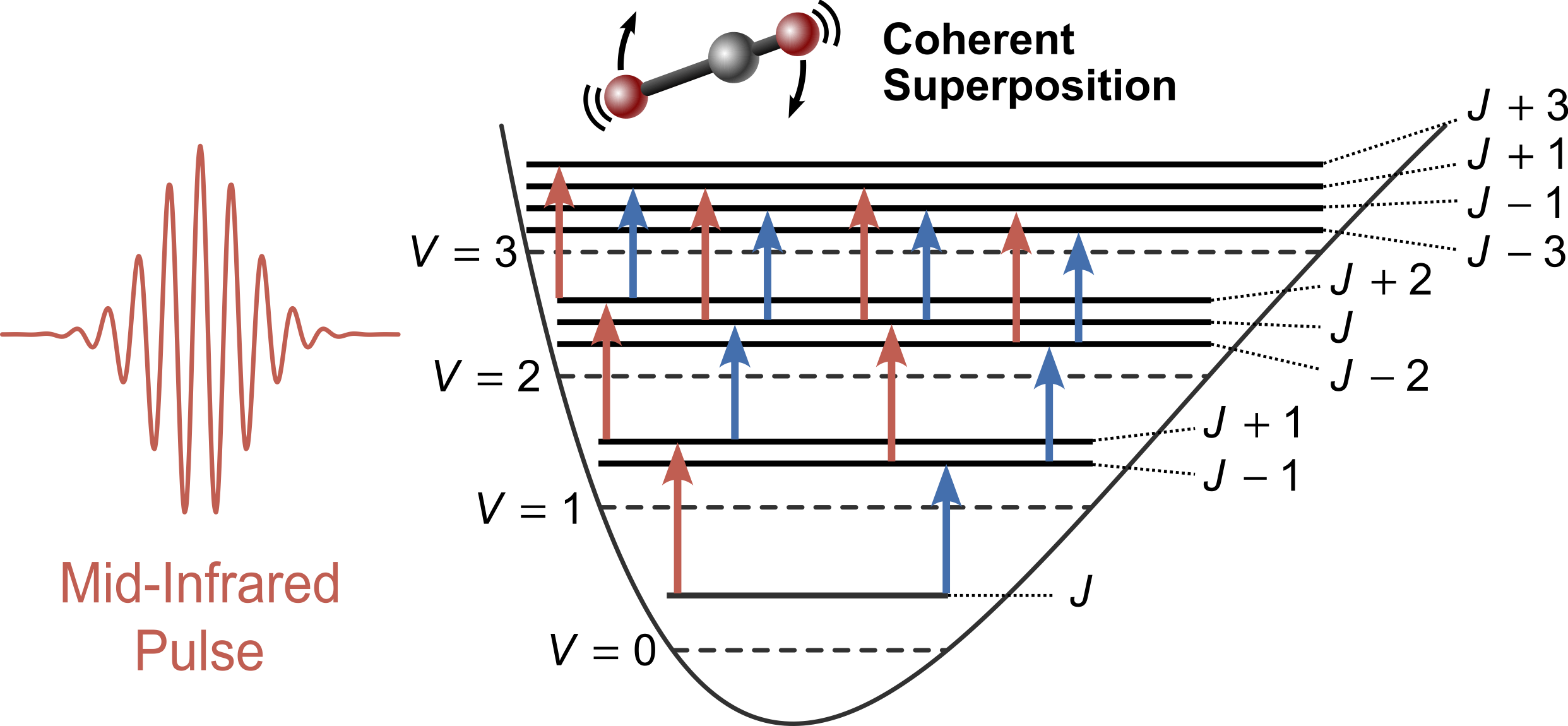
CO₂分子は化学的に安定であり、その変換には大きなエネルギーを必要とします。加熱ではエネルギーが分子全体の運動へ分配されますが、中赤外光は電子基底状態のまま特定の分子振動を選択的に励起できます。私たちは、高強度中赤外パルスを用いてCO₂分子の逆対称伸縮振動を多段階に励起し、高エネルギー状態の生成と振動・回転運動の制御に取り組んでいます。
Carbon dioxide (CO₂) is chemically stable and requires a large energy input for its conversion. While thermal energy is distributed among many molecular motions, mid-infrared light can selectively excite a specific vibration in the electronic ground state. We use intense mid-infrared pulses to generate highly excited states of the antisymmetric stretch of CO₂ and to control its vibrational and rotational motions.
結果|高振動状態と回転波束の生成に成功
Results | Successful generation of highly excited states and rotational wave packets
CO₂を溶かしたポリエチレングリコール溶液では、時間波形を整形した中赤外パルスにより、逆対称伸縮振動を第9振動準位まで励起することに成功しました[1]。この状態のエネルギーは約2.5 eVで、CO₂の結合解離エネルギーの46%に相当します。さらに気相CO₂では、第11振動準位・第40回転準位までの多段階振動・回転励起と、高振動状態における回転波束の生成を実証しました[2]。これらはCO₂変換そのものの実証ではありませんが、反応に関わる高エネルギー分子状態を選択的に生成・制御する基盤となる成果です。
In a CO₂-dissolved Polyethylene Glycol solution, we have successfully demonstrated that temporally shaped mid-infrared pulses excited the antisymmetric stretch of CO₂ up to the 9th vibrational level [1]. This energy is corresponding to 2.5 eV or 46% of the bond-dissociation energy. In gaseous CO₂, we have further demonstrated multistep rovibrational excitation up to the 11th vibrational level and 40th rotational level, where rotational wave packets were generated in highly excited vibrational states [2]. These results provide a basis for selectively generating and controlling highly energetic molecular states relevant to future CO₂ conversion.
- I. Morichika, H. Tsusaka, and S. Ashihara, “Generation of High-Lying Vibrational States in Carbon Dioxide through Coherent Ladder Climbing,” J. Phys. Chem. Lett. 15, 4662–4668 (2024).
- H. Tsusaka, I. Morichika, and S. Ashihara, “Coherent multistep rovibrational excitation using intense midinfrared pulses,” Physical Review Research 6, L042058 (2024).